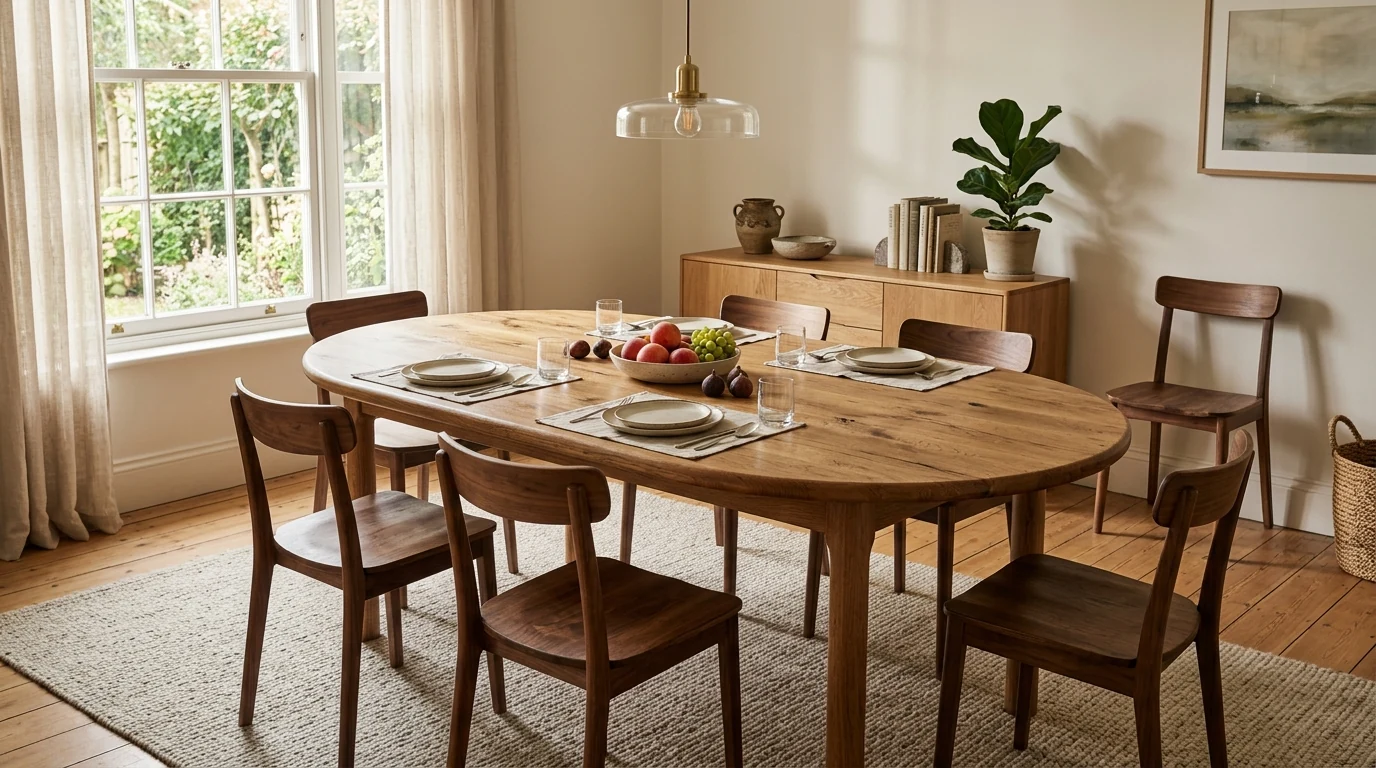
An oval dining table brings people closer without crowding the room—no sharp corners, smoother circulation, and a naturally welcoming shape for meals that stretch from weeknights to weekends. Our team designed the Elegant Oval Solid Wood Dining Table to anchor your dining space with the warmth of real wood and a refined profile that suits both modern and classic interiors.
When you switch from a rectangle to an oval, the whole room tends to feel more relaxed and “open,” even if your square footage stays the same. That shift comes down to how you move around the table and how you sit with the people you’re sharing it with.
| Shape | Best for | Room flow | Typical trade-off |
|---|---|---|---|
| Oval | Everyday dining + hosting with softer lines | High (no corners to clip walkways) | Usually needs a bit more length than round for the same seat count |
| Round | Small rooms, equal conversation | Very high | Less surface for serving platters and place settings at larger sizes |
| Rectangular | Defined, linear layouts and formal symmetry | Medium | Corners can feel sharp in tight clearances; seating can feel “end-focused” |
Solid wood has a presence you can feel day to day. It adds warmth, softens harder finishes, and tends to look better as your home evolves rather than feeling dated.
Wood is also a living material—meaning it can expand and contract slightly with seasonal humidity. That’s normal, and it’s part of why stable indoor conditions matter. For deeper background on wood behavior and construction, see the USDA Forest Products Laboratory Wood Handbook and humidity guidance from the National Wood Flooring Association.
The right table is only half the equation; the other half is giving it space to work. If you’re deciding between sizes, start with clearances rather than seat count.
If your dining area is also a main walkway, an oval is often the friendliest option because you don’t lose circulation to corners. That’s one reason our team likes an oval for open-plan homes where the table has to “share” space with the kitchen and living area.
Great dining tables get used—often. A few low-effort habits help keep the finish looking consistent and reduce the chance of heat rings or cloudy spots.
| Habit | How often | Why it helps |
|---|---|---|
| Quick wipe after meals | Daily/as needed | Prevents residue buildup and water spotting |
| Use placemats/coasters | Every meal | Reduces heat and moisture transfer |
| Gentle cleaner (wood-safe) | Weekly or as needed | Maintains finish without stripping |
| Rotate décor/centerpieces | Monthly | Helps the surface age evenly and reduces shadowing |
For a functional countertop-to-table transition, our team likes pairing dinner-ready staples nearby. The Nordic Ceramic Seasoning Jar Set – Creative Kitchen Spice Storage Box keeps everyday flavors close without adding visual noise to your tabletop.
If you’re choosing one anchor piece to define the room, start with the table. Our Elegant Oval Solid Wood Dining Table is built to be that daily landing spot—meals, projects, celebrations, and everything in between.
A practical range depends on table length and chair width, but many oval tables seat about 4–6 comfortably at smaller sizes and 6–8 as length increases. Armless chairs tend to fit more easily, and the rounded ends usually allow a bit more flexibility than sharp rectangular corners when you’re squeezing in an extra place setting.
Use coasters, trivets, and placemats consistently, and wipe spills promptly with a soft cloth. Stick to gentle, wood-safe cleaners and avoid harsh chemicals or leaving standing water on the surface for extended periods.
Yes—curved edges can improve traffic flow and reduce that “tight corner” feeling in small spaces. Measure your clearances carefully, consider slimmer chair profiles, and use a properly sized rug and centered lighting to define the dining zone without adding bulk.









Leave a comment